
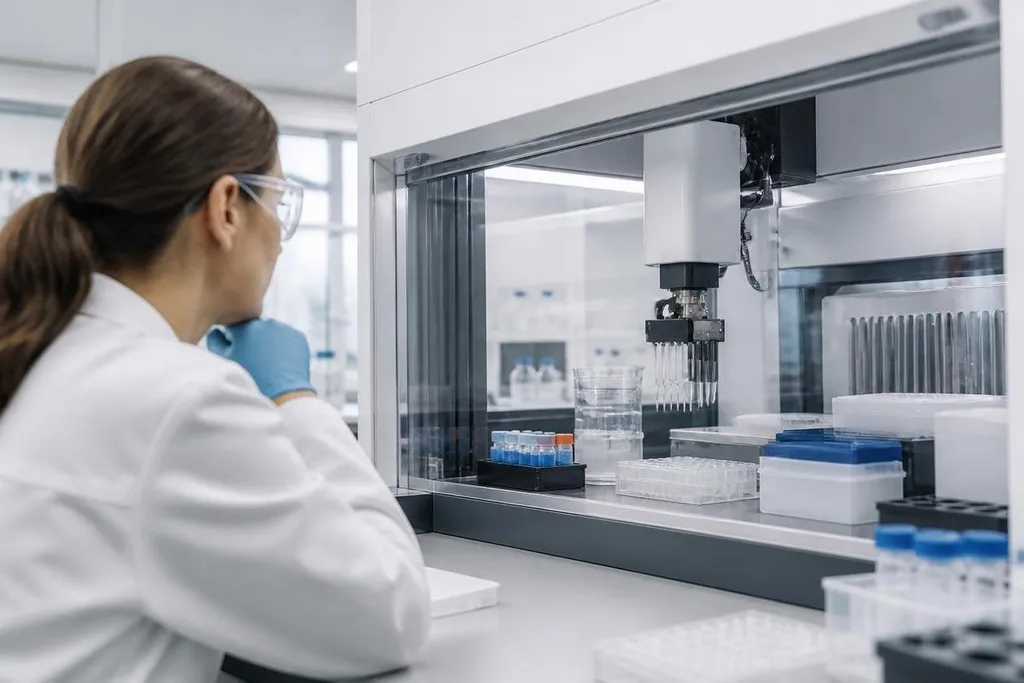
AI is changing laboratory robots by letting them adjust actions from what their cameras and sensors detect. That can help with tasks where every sample, container, or setup looks slightly different, but the robot still needs clear limits and checks.
- Robots can inspect samples before acting.
- Software can adjust movement when a setup shifts.
- Repeatable results still need records and human checks.
From fixed steps to sensor-led work
Traditional laboratory robots follow set instructions. A liquid handler moves to known positions, picks up a container, and dispenses a measured amount. That works well when the layout, tools, and sample types stay the same.
AI changes the first step. Computer vision can help a robot identify a tube, plate, vial, or other item before the arm moves. The system can then choose a stored motion that matches the item’s position, rather than assuming every object sits in one exact place.
That matters in labs where people load equipment by hand. A tube can sit at an angle. A plate can shift in its holder. A robot that checks the scene before moving has more information than one that follows fixed coordinates.
The limit is plain: recognition errors can send the arm toward the wrong object. The lab still needs a safe stop, a clear error message, and a person who can check the item.
Learning from past runs
AI can also use records from earlier tasks. A system may compare a new image, sensor reading, or test result with past runs and flag a change. That gives lab staff a chance to inspect a sample before the robot repeats the next step.
The useful part is the link between a result and an action. If a robot sees that a sample has moved, it may pause and ask for a check. If a gripper detects more resistance than expected, the software can stop the motion instead of pushing harder.
Those actions need traceable records.
Lab staff should be able to see which input the software used, what motion it chose, and why the run stopped. Without that record, a good result is hard to repeat and a bad result is hard to investigate.
Those records give AI in laboratory robotics a fair test: what did the software change, and could staff trace each choice after the run? The useful question is where those decisions reduce work without hiding the reason for a stop.
Where AI can help most
AI fits tasks with changing inputs better than tasks with fixed positions. It can help sort objects, inspect surfaces, adjust a grip, or plan a route around items on a workbench.
A robot may also use language software to turn a lab instruction into a sequence of actions. That can make setup faster for a trained operator, but the instruction still needs a check before the arm runs. A vague command can hide a wrong sample, wrong tool, or wrong disposal step.
The system should also keep physical safety separate from language. A text model can suggest an action. It should not decide that an open door, a person’s hand, or an unknown object is safe to ignore.
What still needs proof
The hardest test is repeatability. A lab robot must produce the same result across different samples, lighting conditions, tools, and operators. A software demo on one workbench says little about that wider test.
AI systems can also change after their training data, software, or camera setup changes. Each change needs a record and a new check. The robot’s speed matters less if staff must inspect every move by hand.
I'd wait for measured error rates and run records before trusting an AI system with high-cost samples. The claim that matters is not that the robot can see; it is how often that sight leads to the right action.
A buying checklist for lab teams
Use these checks before adding AI to a laboratory robot:
- Name the task. Write down the exact step AI will handle and the result it must produce.
- Set a stop rule. Make the robot pause when vision, force, or sample data falls outside set limits.
- Keep a record. Store the input, chosen action, software version, and operator approval for each run.
- Test the edge cases. Include shifted containers, poor lighting, damaged tools, and empty positions.
- Check the fallback. Give staff a manual process that works when the model cannot decide.
- Measure repeatability. Compare AI-assisted runs with the lab’s existing method before wider use.
The best near-term use is narrow: let AI handle changing visual or physical details, while fixed software controls the steps that must stay exact. Until labs publish error rates across real conditions, treat broad claims about autonomous laboratory work as a plan to test, not a result.